
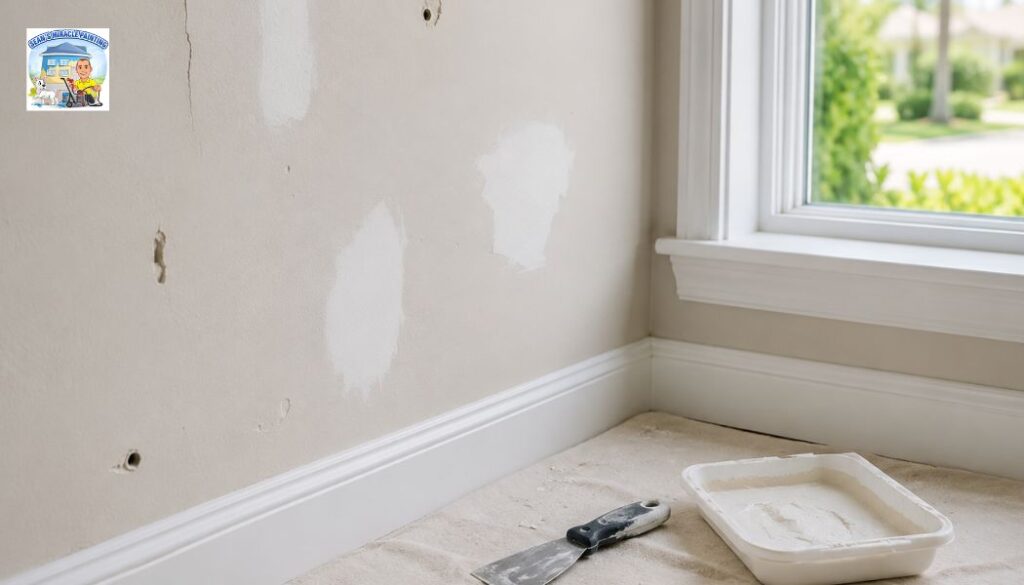
You’ve picked the color, bought the rollers, maybe even booked a painter, and then you notice it. A hairline crack over the bedroom door. A brown ring on the ceiling near the AC vent. A little bump where a picture hook used to be. Do you paint over it, or deal with it first?
In Englewood, the answer is almost always: deal with it first. Between Gulf Coast humidity, storm season moisture, and homes that have quietly settled for 20+ years, drywall damage here isn’t just cosmetic, it’s often the reason a paint job looks great for six months and then doesn’t. Fresh paint, especially in satin or eggshell finishes, reflects light and makes every dent, seam, and repair line more visible, not less. It’s a magnifier, not a mask.
Here’s how to read the warning signs on your own walls before a single drop of paint goes on.
1. Hairline Cracks Around Doors and Windows
A thin crack running diagonally from the corner of a door or window frame is one of the most common calls we get in Englewood. It usually points to normal seasonal movement, Florida homes expand and contract with heat and humidity swings, and drywall seams take the strain first.
The problem isn’t the crack itself; it’s what happens if you paint over it untreated. Paint has zero structural flexibility. The crack reopens within a season, and now it’s reopening through a fresh coat instead of bare drywall, which means redoing the whole section, not just the patch.
2. Nail Pops (Those Small Round Bumps)
Run your hand across the wall in indirect light and you’ll feel them before you see them: small, circular bumps, sometimes with a faint ring-shaped crack around the edge. This happens when the wood framing behind the drywall shrinks slightly as it dries out, pushing the fastener head outward.
Painting over a nail pop just gives you a freshly painted bump. The fastener needs to be reset or replaced with a new screw driven into solid framing nearby, then floated and sanded flush, otherwise it telegraphs straight through even a premium paint finish.
3. Water Stains – Even Old, Dry Ones
Yellow, brown, or tan rings on a ceiling or upper wall are a moisture signature, and in Southwest Florida that usually traces back to a roof leak, AC condensation line, or a slow plumbing leak. Here’s the part homeowners get wrong most often: even if the stain feels bone-dry today, standard paint won’t seal it. The tannins bleed straight through, and the stain reappears within weeks of painting.
Water-damaged drywall needs the source of the leak confirmed as fixed, the affected section cut out or thoroughly dried, and a stain-blocking primer applied before any topcoat goes on. Skipping that step is the single most common reason a “finished” paint job looks stained again by the next rainy season.
At Sean’s Miracle Painting, we follow this full restoration process before any repainting, ensuring the surface is properly sealed so stains don’t return and the finish holds up through Florida’s humidity and storms.
4. Peeling or Bubbling Paint
If your existing paint is bubbling, flaking, or lifting at the edges, that’s not a paint problem, it’s a moisture or adhesion problem underneath. Painting directly over peeling paint just gives the new coat something unstable to grip onto, and it will fail again, often faster than the first time.
The fix is to scrape back to solid material, feather the edges so there’s no visible ridge, and prime before repainting.
5. Soft, Spongy, or Bulging Drywall
Press gently on a suspicious spot near a bathroom, kitchen, or exterior wall. If it gives slightly or feels spongy rather than solid, that section is likely holding moisture, a strong candidate for hidden mold behind the surface. This is not a patch-and-paint situation. It needs the damaged section removed, the moisture source addressed, and often a full section replacement before finishing work can safely happen.
6. Visible Seams or Shadow Lines Under Angled Light
Stand to the side of a wall and look down its length in natural light. If you can see faint ridges or shadow lines where drywall sheets meet, the joint compound wasn’t feathered wide enough during the original installation or a past repair. It’s mostly cosmetic, but it will show up worse, not better, once a fresh, higher-sheen paint goes over it.
7. Damaged or Dented Corners
Outside corners (the ones with a metal or plastic corner bead underneath) take the brunt of daily life: vacuum bumps, furniture moves, kids and pets. A dented or exposed corner bead won’t hide under paint, it needs to be re-beaded and floated back to a clean, sharp edge, or the corner will look damaged forever, paint or no paint.
Why This Matters More in Englewood Specifically
Southwest Florida’s combination of high humidity, seasonal storms, and older housing stock means drywall issues here are rarely “just cosmetic.” A quick tube of spackle might hide a nail hole for a photo, but it won’t hold up to the moisture cycles this climate puts walls through. Proper repair means multiple thin coats of joint compound with full drying time between each, wide feathering so patches disappear rather than telegraph, and, for textured walls, which are common in Englewood’s knockdown and orange-peel finishes, matching the existing texture so the repair is invisible once painted.
This is also why the “80/20 rule” holds true on most professional paint jobs: roughly 80% of the work that determines how good a paint job looks is in the prep, and only 20% is the actual painting.
DIY or Call a Pro?
A small nail hole or shallow scuff is a reasonable weekend fix, spackle, a light sand, done. But if you’re seeing any of the following, it’s worth getting a professional opinion before you pick up a paintbrush:
- Cracks that have come back after a previous patch
- Any water staining, past or present
- Soft, spongy, or bulging sections
- Textured walls where a mismatched patch would stand out
- Damage larger than a few inches
Getting it wrong at the drywall stage doesn’t just risk a bad-looking wall, it risks redoing the entire paint job within a year.
Ready for a Walls That Actually Look Finished?
If you’re planning a repaint in Englewood, Venice, Port Charlotte, or the surrounding area, walk through our full drywall repair process, hole repair, crack repair, water damage repair, nail pop fixes, corner bead repair, and texture matching, all done before we ever open a paint can. We can handle drywall repair only, or repair plus paint so the finished wall is done in a single visit. Schedule a free estimate with Sean’s Miracle Painting and let’s find out what’s really going on behind that paint.
FAQ
Can I just paint over small drywall cracks instead of repairing them?
No, paint has no flexibility, so a crack painted over will almost always reopen within a season, especially in Florida’s humidity swings. It needs to be cleaned out, filled, and taped first.
How do I know if a water stain is still active or just an old mark?
Press the area gently, if it feels soft or spongy, moisture is likely still present. Even dry, old stains need a stain-blocking primer, or the discoloration will bleed through new paint.
Will my textured walls look different after a drywall repair?
Not if the texture is matched correctly. Knockdown, orange peel, and skip trowel are all common in Englewood homes, and a properly matched repair should be invisible once painted.
How many coats of joint compound does a repair really need?
Most professional repairs use three thin coats with full drying time between each. Rushing this step is the most common reason repairs show through fresh paint.
Does Sean’s Miracle Painting handle both the repair and the painting?
Yes, we offer drywall repair on its own, or repair plus paint so your walls go from damaged to finished in one visit.